
In recent years, artificial intelligence has taken center stage in the technology landscape. From AI writing assistants and image generators to advanced video creation tools, capabilities once reserved for professionals are now widely accessible. While much of this transformation is attributed to increasingly powerful algorithms, a deeper shift is happening beneath the surface—one that is far more foundational.
As AI becomes embedded in everyday workflows, the supporting infrastructure—data, devices, and especially connectivity—is evolving in parallel.
Data in the AI Era Is Bigger, Faster, and Constantly Moving
The definition of “data” has changed dramatically. What once meant documents and simple images now includes AI-generated videos, ultra-high-resolution visuals, and even locally stored machine learning models.
These new data types share three characteristics: larger file sizes, higher frequency of creation, and more frequent movement between devices. File transfer is no longer an occasional task—it has become a continuous, almost invisible part of digital workflows.
This shift places new demands on the infrastructure that supports data movement. The efficiency of connections is no longer a secondary concern—it is central to productivity.
Connectivity Becomes a Core Experience Factor
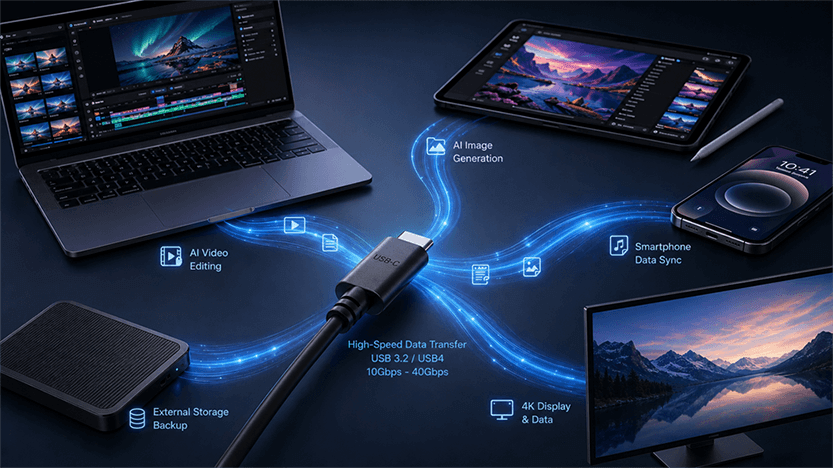
Modern workflows are inherently multi-device. Content may be captured on a smartphone, edited on a laptop, stored on an external drive, and displayed on a larger screen. AI-generated assets often move across multiple environments before reaching their final form.
In this context, connectivity directly shapes user experience. Whether a file transfer takes seconds or minutes, whether devices connect instantly or require repeated adjustments—these seemingly minor details can significantly impact efficiency.
As a result, “connection” has evolved from a background feature into a critical performance factor.
Why USB-C Is Becoming the Universal Standard
A clear industry trend has emerged: devices are rapidly converging around the USB-C interface. Laptops, tablets, smartphones, monitors, and even professional equipment are increasingly adopting this unified standard.
The reason is straightforward. As device ecosystems expand and data volumes grow, fragmented connection standards introduce unnecessary complexity. A universal interface reduces friction, simplifies workflows, and improves compatibility across devices.
USB-C addresses a fundamental need in the AI era: enabling seamless interaction between devices without interrupting the creative process.
USB-C: From Charging Port to Data Backbone
USB-C is not new, but its role has evolved significantly. It is no longer just a charging interface—it has become a high-performance data channel.
With support for advanced standards such as USB 3.2 and USB4, USB-C enables high-speed data transfer that is essential for AI-driven workflows. Large files—such as 4K video footage, AI-generated content, or local model data—can now be transferred in seconds rather than minutes.
This capability transforms how work is done. Faster transfers enable more iterative workflows, reduce waiting time, and allow users to focus on creation rather than logistics.
The Often-Overlooked Details That Shape Experience
In discussions about technology, attention often focuses on major components such as processing power or software capabilities. However, real-world experience is equally influenced by less visible factors.
For example, transferring a large video file using an older USB 2.0 connection can take significantly longer than using USB 3.2 or USB4. While the difference may be negligible for small files, it becomes substantial when dealing with high-resolution or AI-generated content.
These inefficiencies are common, yet they are often mistaken for device limitations rather than connection constraints. As hardware performance improves, tolerance for such bottlenecks continues to decrease.
The Role of Professional USB-C Brands in the Ecosystem
As USB-C becomes the backbone of modern connectivity, the quality of cables and accessories plays an increasingly important role. Not all USB-C solutions are created equal—performance can vary significantly depending on design, materials, and supported protocols.
This is where specialized brands like VCOM stand out. As a professional USB-C product brand, VCOM focuses on delivering reliable, high-performance connectivity solutions tailored for modern digital workflows. From high-speed data cables to multi-functional hubs, such products are designed to fully support advanced standards like USB 3.2 and USB4, ensuring stable transmission and consistent performance.
In an environment where efficiency depends on seamless data flow, the reliability of connection tools becomes just as important as the devices themselves.
From “Faster Processing” to “Seamless Connection”
User expectations are evolving. Performance is no longer defined solely by computing speed—it also includes how smoothly devices interact.
Seamless connectivity, instant data transfer, and effortless switching between devices are becoming baseline expectations. In this context, USB-C represents more than a technical upgrade; it reflects a shift toward simplified, integrated experiences.
Endnote: A Quiet but Fundamental Shift
The AI revolution is often framed in terms of intelligence—smarter systems, better models, and more powerful tools. But these advancements rely on an equally important foundation: the ability to move data efficiently and connect devices seamlessly.
USB-C is emerging as a key enabler of this transformation. By unifying interfaces and delivering high-speed connectivity, it supports the growing demands of AI-driven workflows while reducing complexity.
As technology continues to evolve, the focus will not only be on how fast systems can compute, but also on how effortlessly they can connect. In this sense, USB-C is not just a standard—it is a critical piece of the infrastructure powering the AI era.
Tag:USB C,AI