
In modern homes, offices, and data centers, network performance is no longer only about internet speed. The Ethernet cable behind the router, switch, gaming PC, NAS, PoE camera, or enterprise server also determines whether a network can run stably under heavy data traffic. As the newest high-performance copper Ethernet category, Cat 8 is often promoted as the “best Ethernet cable.” Technically, Cat 8 does offer the highest speed and bandwidth among common twisted-pair Ethernet cables. However, the real answer is more practical: Cat 8 is the best choice for short-distance 25G/40G professional networks, but it is not always the best choice for every home or office.
What Is Cat 8 Ethernet Cable?
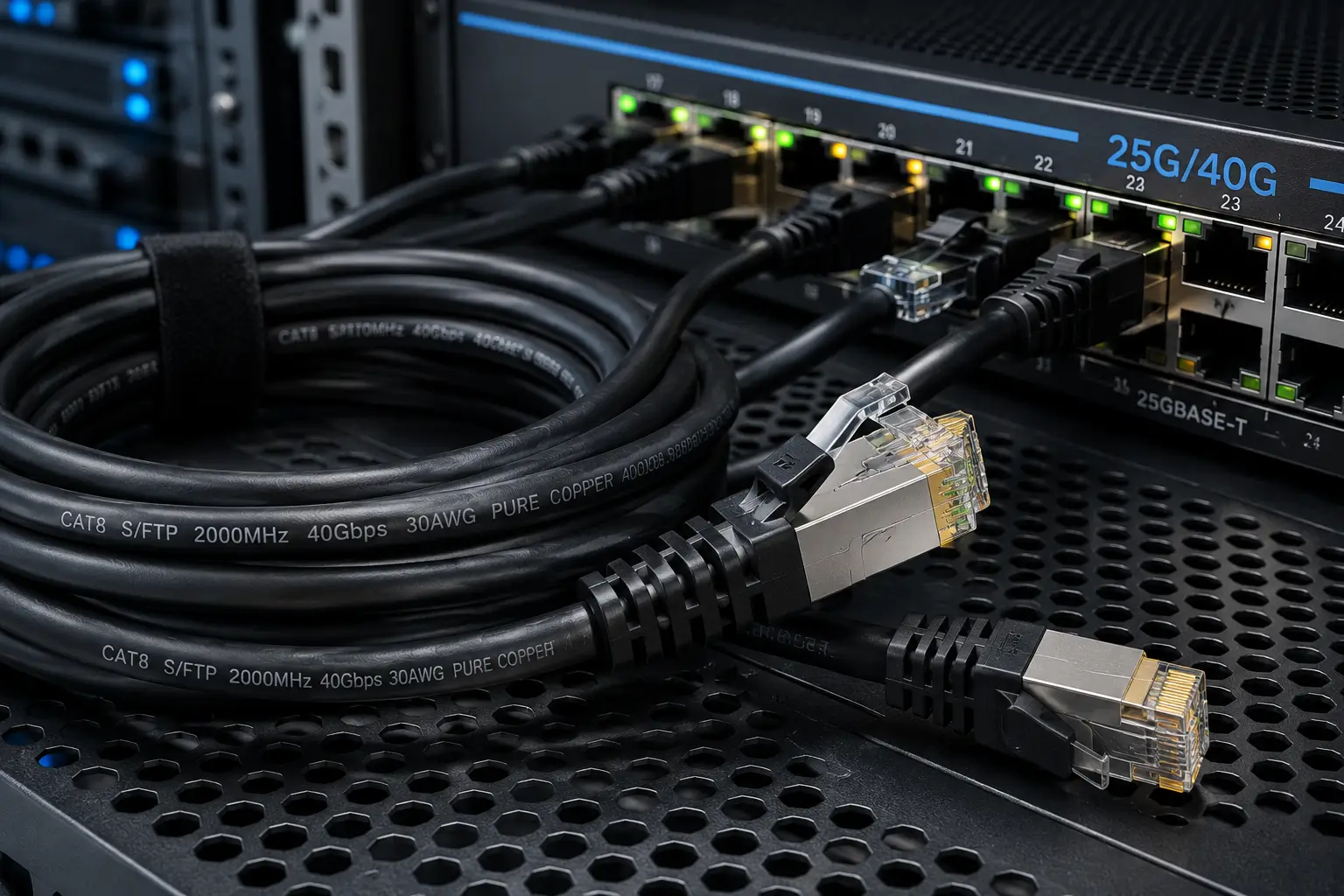
Cat 8, short for Category 8, is a shielded twisted-pair Ethernet cable designed for extremely high-speed copper network transmission. It supports 25Gbps and 40Gbps Ethernet applications, with bandwidth up to 2000MHz and a maximum channel distance of 30 meters for 25GBASE-T and 40GBASE-T. The IEEE 802.3bq 25G/40GBASE-T standard was approved in 2016, establishing high-speed Ethernet operation over balanced twisted-pair cabling.
Compared with older cable categories, Cat 8 is built for demanding environments where speed, shielding, and low signal interference matter.
Cat 8 Speed and Bandwidth: Why It Looks Like the Best
The biggest advantage of Cat 8 is performance. While Cat5e supports up to 1Gbps and Cat6 can support 10Gbps over shorter distances, Cat8 pushes copper Ethernet into the 25Gbps and 40Gbps range. Cat 8 has a maximum permanent link length of 24 meters and a maximum channel length of 30 meters when supporting 25 Gbps and 40 Gbps speeds. It can still support 10Gbps and lower speeds at a full 100-meter channel configuration.
Bandwidth is another important factor. Cat 8 reaches up to 2000 MHz, far above Cat6 at 250 MHz and Cat6a at 500 MHz. Higher bandwidth means the cable can handle a wider signal frequency range, reducing bottlenecks in high-density data transmission. For server rooms, network storage, switch-to-switch links, and high-performance workstations, this can be a clear advantage.
Is Cat 8 Better Than Cat6 or Cat6a?
From a pure specification perspective, yes. Cat 8 is faster and has higher bandwidth than Cat6 and Cat6a. But in real-world selection, “better” depends on the network equipment and installation distance.
For most homes, Cat6 is already powerful enough. It supports 1Gbps at 100 meters and 10Gbps over shorter runs. Cat6a is often a more balanced upgrade because it supports 10Gbps at up to 100 meters and offers strong future-proofing for home offices, studios, small businesses, and advanced gaming setups. Cat 8, by contrast, is limited to 30 meters for 25G/40G applications. This makes it excellent for data center racks, but less practical for long building cabling.
Another point is hardware compatibility. A Cat 8 cable will not automatically make a 1Gbps router run at 40Gbps. The router, switch, network card, storage device, and ports must all support the target speed. If the whole network is still based on Gigabit Ethernet, Cat 8 may work reliably, but its extra performance will not be fully used.
Cat 8 vs Cat7: Which One Should You Choose?
Cat7 is also shielded and commonly rated for 10Gbps with a bandwidth of around 600MHz. It provides strong noise resistance, making it useful in industrial environments or places with heavy electromagnetic interference. However, Cat8 is a newer and higher-performance standard for 25G/40G Ethernet. Category 8.2 cabling supports 30-meter Class II channels for IEEE 802.3bq 25GBASE-T and 40GBASE-T applications, with transmission performance up to 2000MHz.
For users choosing between Cat7 and Cat8, the decision should be based on the application. For a high-end home network, Cat6a is often more reasonable than both. For industrial noise resistance, Cat7 can be sufficient. For short-distance, high-speed enterprise deployment, Cat8 is the more advanced option.
When Cat 8 Is the Best Ethernet Cable
Cat 8 is the best Ethernet cable when the network requires very high throughput over short copper links. It is especially suitable for:
Data centers with switch-to-server connections
Enterprise backbone networks
High-performance NAS or server rooms
Short-distance 25Gbps or 40Gbps copper links
Environments with strong electromagnetic interference
Because Cat 8 is fully shielded, it can reduce crosstalk and external interference more effectively than unshielded cables. This is valuable in professional installations with dense cabling, high-power equipment, and continuous data transmission.
When Cat 8 Is Not Necessary
For ordinary home networks, Cat 8 is usually more than needed. Most home broadband plans, routers, smart TVs, game consoles, and laptops still use 1Gbps or 2.5Gbps Ethernet. Even many advanced home users only need 10Gbps for NAS storage, video editing, or local file transfer. In these cases, Cat6a offers excellent performance, longer distance, easier installation, and better cost control.
Cat 8 cables are also thicker and less flexible because of their shielding structure. Poor-quality “Cat 8” cables on the market may not meet real certification requirements, so buyers should avoid choosing by printed label alone. Cable structure, conductor material, shielding quality, connector quality, and test certification are all important.
How to Choose the Right Ethernet Cable
The most reliable way to choose an Ethernet cable is to match it with the actual network environment. For basic home internet, Cat5e can still handle Gigabit networks. For gaming, 4K streaming, office use, and general future-proofing, Cat6 is a cost-effective choice. For 10Gbps home offices, studios, and small business networks, Cat6a is often the best balance. For industrial areas with strong interference, shielded Cat6a or Cat7 may be suitable. For short-distance 25G/40G professional networks, Cat8 is the right choice.
Quality should also be considered. A high-category cable with poor materials may perform worse than a certified lower-category cable. Look for pure copper conductors, stable shielding, reliable RJ45 connectors, clear category markings, and compliance testing. For business use, choosing a trusted cabling brand such as VCOM helps ensure stable transmission, durability, and long-term value.
Tag:CAT 8,Cable