
Placing a phone on a pad and watching it charge—no cables involved—has quickly become a daily habit for many users. That’s wireless charging. But questions often come up:
Does it produce harmful radiation?
Why does it sometimes get warm?
Why do different chargers perform so differently?
Here's a clear, no-nonsense breakdown.
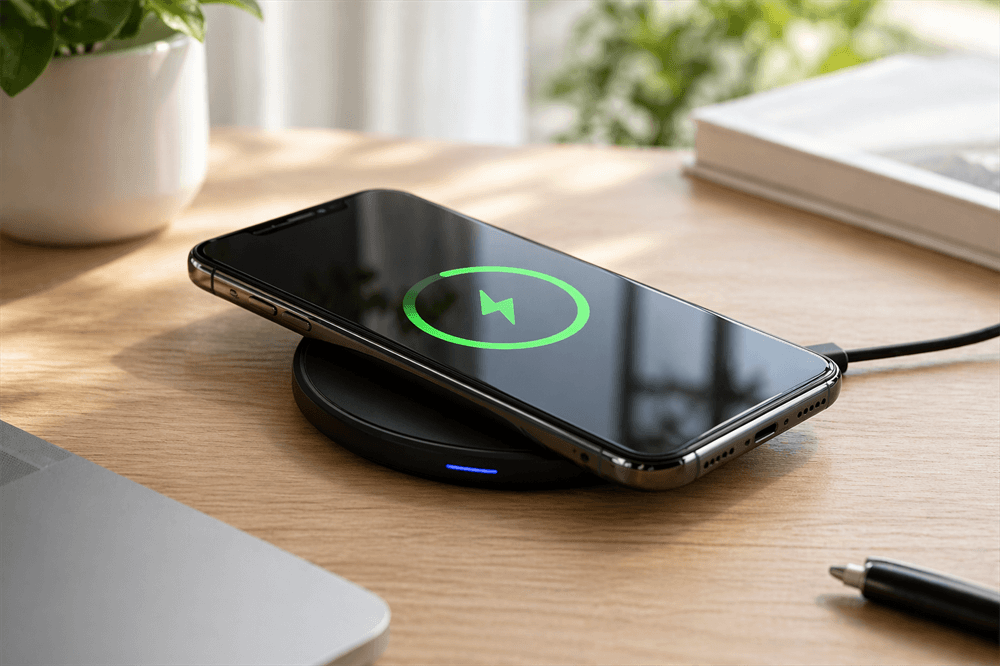
How Wireless Charging Works
Most wireless chargers today follow the Qi standard developed by the Wireless Power Consortium.
The principle is straightforward:
The charger generates an electromagnetic field
The phone receives that energy and converts it into electricity
In simple terms, it's short-range power transfer without physical contact.
Why Wireless Charging Generates Heat
Compared to wired charging, wireless charging can feel warmer—and that’s normal. Key reasons include:
Energy Loss During Transfer
Wireless power transfer isn’t 100% efficient. Some energy is inevitably lost as heat.
Misalignment
If the phone isn’t properly aligned with the charging coil:
Efficiency drops
Heat increases
Metal Objects in Between (Critical Factor)
Items like coins, keys, or metal cards can absorb energy and heat up through induction. This is one of the most important safety considerations.
A Crucial Safety Feature: FOD (Foreign Object Detection)
To address the risk of unintended heating, quality wireless chargers include FOD technology.
What it does:
Detects abnormal metal objects
Automatically reduces power or stops charging
Example scenario:
A coin is accidentally left between the phone and the charger:
Without FOD → the coin may heat
With FOD → charging is halted to prevent risk
This is a key reason why some chargers feel noticeably safer than others.
Why Charging Experience Varies Across Products
Not all wireless chargers deliver the same performance. Differences usually come down to:
Power Management
High-quality chargers dynamically adjust output for stable and efficient charging.
Thermal Control
Includes:
Intelligent chip regulation
Heat dissipation design
FOD Implementation
Better detection systems respond faster and more accurately.
Standards Compliance
Qi-certified devices generally offer better compatibility and reliability.
What to Look for When Choosing a Wireless Charger
No need to dive deep into specs—focus on these essentials:
Qi certification for broad compatibility
Safety features (FOD, temperature protection)
Thermal performance (stable heat control over time)
Build quality (materials and heat dissipation design)
Is Wireless Charging Safe?
Yes—wireless charging is fundamentally safe.
The key condition:
The product must include robust safety mechanisms, especially foreign object detection and thermal management.
When those are in place, wireless charging is not only convenient—but also reliable for everyday use.
Tag:Wireless Charging