
In the rapidly evolving landscape of audio-visual (AV) technology, the General Purpose Media Interface (GPMI) emerges as a groundbreaking standard designed to unify multiple connectivity functions into a single cable. Developed by the Shenzhen 8K UHD Video Industry Cooperation Alliance (SUCA), a consortium of over 50 Chinese technology companies, including Hisense, Skyworth, TCL, and Huawei, GPMI was officially announced in April 2025. This interface addresses the limitations of current standards by integrating uncompressed ultra-high-definition video, high-fidelity audio, data transmission, control signals, and power delivery—all through one bidirectional connection.
GPMI represents a strategic push toward simplifying device ecosystems, reducing cable clutter, and supporting future-proof resolutions like 8K at 120 frames per second. As electronics continue to demand higher bandwidth and versatility, GPMI positions itself as a potential successor to entrenched protocols, promising seamless integration across diverse applications.
Key Features and Specifications
GPMI stands out with its robust specifications tailored for high-performance AV systems. The standard supports data transmission rates of up to 192 Gbps for Type-B connectors and 96 Gbps for Type-C, enabling the delivery of ultra-high-definition content far beyond current capabilities. Power delivery is equally impressive, with Type-B offering up to 480W and Type-C up to 240W, sufficient to charge devices while transmitting signals.
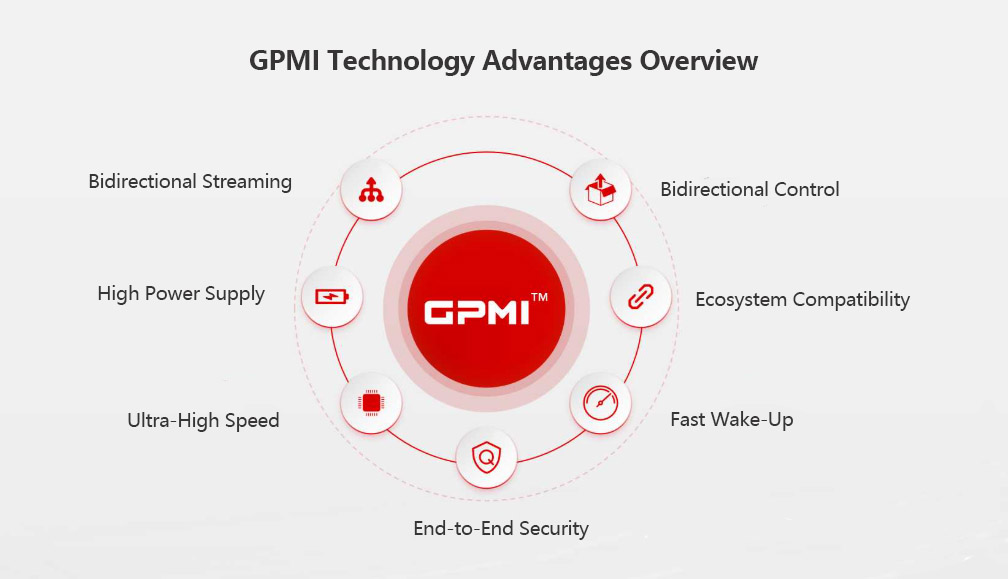
Key features include bidirectional communication for audio, video, data, and control signals, support for daisy-chain networking, and compatibility with Ethernet for integrated network connectivity. The Type-C variant utilizes the familiar USB-C connector for compact devices, while Type-B provides a larger, proprietary option for maximum performance in professional setups. Additionally, GPMI incorporates fast wake-up functionality and AV-over-IP readiness, making it ideal for smart terminals and AI-driven systems.
Feature | GPMI Type-B | GPMI Type-C |
Bandwidth | 192 Gbps | 96 Gbps |
Power Delivery | 480W | 240W |
Connector Type | Proprietary | USB-C Compatible |
Key Capabilities | Video/Audio/Data/Power/Control/Ethernet | Video/Audio/Data/Power/Control |
Comparison with Existing Standards
When benchmarked against established interfaces like HDMI 2.1, DisplayPort 2.1, and USB-C, GPMI demonstrates superior versatility. HDMI 2.1 tops out at 48 Gbps, with no native power delivery, and focuses primarily on video and audio. DisplayPort offers up to 80 Gbps but lacks integrated power and networking features. USB-C, while versatile with up to 240W power and 80 Gbps data, does not natively optimize for ultra-high-definition AV transmission.
GPMI's all-in-one approach eliminates the need for multiple cables, surpassing HDMI in bandwidth by a factor of four and integrating power akin to advanced USB standards. This convergence reduces complexity in setups, such as home theaters or professional AV installations, where separate power and data lines traditionally complicate designs.
Applications and Use Cases
GPMI's design lends itself to a broad spectrum of applications in electronics. In consumer electronics, it simplifies connections for 8K TVs, gaming consoles, and smart displays by providing video, audio, and internet access via one cable. Automotive systems benefit from their robust power delivery and data integration, enabling infotainment screens and AI-assisted dashboards without additional wiring.
Industrial sectors, including manufacturing and healthcare, leverage GPMI for high-resolution monitoring and control systems, supporting up to 128-node daisy chaining for scalable networks. In professional AV environments, such as video production studios, the interface facilitates seamless integration of cameras, monitors, and servers, enhancing workflow efficiency.
Advantages and Potential Challenges
The primary advantages of GPMI lie in its simplification of connectivity, reducing cable clutter and installation costs while boosting performance for future technologies like 8K and beyond. Its non-proprietary nature, backed by major manufacturers, could lead to cost-effective adoption and broader compatibility.
However, challenges include global adoption outside China, potential compatibility issues with legacy devices, and the need for widespread certification to ensure reliability. Regulatory hurdles and competition from established standards may slow its rollout, though its technical superiority positions it favorably for long-term integration.
The Future of GPMI
As electronics trend toward higher resolutions, AI integration, and IoT ecosystems, GPMI is poised to become a cornerstone standard. Ongoing developments in phases for home entertainment, automotive, and industrial applications suggest a phased global rollout by 2027. With support from key players, GPMI could standardize AV connectivity, driving innovation in smart homes, autonomous vehicles, and immersive media experiences.
Tag:GPMI,HDMI,DP,USB-C