When connecting a laptop, game console, media player, projector, TV, or LED display, HDMI remains one of the most widely used interfaces for audio and video. For short-distance connections, a regular copper HDMI cable is often enough. However, when the distance extends across a large meeting room, home theater ceiling, classroom, monitoring center, or commercial digital signage system, ordinary copper HDMI cables may begin to show their limitations.
This is where an active HDMI fiber optic cable becomes valuable. Also known as an HDMI AOC (Active Optical Cable), it is designed for long-distance, high-bandwidth HDMI signal transmission. Instead of relying mainly on copper conductors, it uses optical fiber to carry high-speed video and audio signals, making it a more practical choice for clean, stable, and long-distance AV installations.
What Is an Active HDMI Fiber Optic Cable?
An active HDMI fiber optic cable is an HDMI cable with built-in signal conversion electronics. At the source end, the cable converts electrical HDMI signals into optical signals. These optical signals travel through fiber inside the cable. At the display end, they are converted back into electrical HDMI signals so that the TV, projector, monitor, or display can read them correctly.
The word “active” is important. Unlike a passive copper HDMI cable, an active optical HDMI cable contains chips that handle signal conversion and transmission management. Many HDMI AOC cables are hybrid designs, using optical fiber for high-speed signal transmission while retaining some copper conductors for low-speed communication, power, or control functions. This structure helps the cable maintain HDMI compatibility while improving long-distance performance.
Ultra High Speed HDMI cables are designed for configurations supporting up to 48Gbps bandwidth, and the HDMI Forum notes that these cables support demanding HDMI 2.1a features such as uncompressed 8K@60 and 4K@120. For long-distance 4K/8K applications, active optical construction gives installers more flexibility than traditional copper-only cabling.
How Does an HDMI AOC Cable Work?
The working principle is simple but highly effective. A standard HDMI signal starts as an electrical signal from a source device, such as a Blu-ray player, desktop PC, laptop, gaming console, NVR, or media player. Inside the HDMI AOC connector, the signal is processed and converted into optical pulses. These pulses travel through the fiber core with minimal signal loss over distance. At the display side, another built-in chip converts the optical signal back into HDMI electrical form.
Because the transmission medium is optical fiber, the cable is much less affected by electromagnetic interference. This is particularly useful in real installation environments where HDMI cables may pass near power lines, lighting systems, motors, network equipment, or other AV devices.
Active HDMI Fiber Optic Cable vs. Regular Copper HDMI Cable
The biggest difference between an HDMI fiber optic cable and a regular HDMI cable is distance performance. A copper HDMI cable carries signals electrically. As length increases, signal attenuation becomes more obvious, especially when transmitting 4K, 8K, HDR, or high-refresh-rate content. The uploaded source draft notes that regular copper HDMI cables are generally not recommended for overly long high-spec 4K/8K runs because signal attenuation becomes more likely.
An HDMI fiber optic cable is designed for longer runs. Some active optical HDMI products can transmit HDMI signals over tens of meters, and certain professional designs reach 75m or 100m depending on specification and installation conditions. Panduit, for example, describes active HDMI cables that extend HDMI 2.0 signals up to 75m and transmit 4K signals from source to display with direction-labeled connectors.
Cable body design is another difference. A long copper HDMI cable can become thick, heavy, and difficult to route through conduits or walls. HDMI fiber optic cables are usually slimmer and lighter at comparable lengths, making them easier to install behind ceilings, under floors, inside walls, or through narrow cable ducts.
Price is also different. Copper HDMI cables are usually more affordable for short distances. HDMI AOC cables cost more because they include optical fiber and active conversion chips. However, in long-distance installations, paying for a reliable AOC cable is often more cost-effective than dealing with signal loss, flickering, black screens, or repeated rework after installation.
Key Advantages of HDMI Fiber Optic Cables
The first advantage is long-distance transmission. For projectors mounted far from the signal source, display walls in shopping malls, classroom AV systems, or large conference rooms, HDMI AOC cables provide a practical way to maintain stable image quality without bulky signal boosters.
The second advantage is signal stability. Optical transmission has strong resistance to electromagnetic interference, which helps reduce display problems such as intermittent signal drops, snow, color distortion, or flickering in interference-heavy environments.
The third advantage is installation convenience. A thinner and lighter cable is easier to pull through conduits and route around corners. This matters in home theater construction, hotel projects, lecture halls, security control rooms, and commercial renovation projects where the cable may be buried or hidden.
The fourth advantage is high-bandwidth support. Depending on the cable specification, HDMI AOC products may support 4K@60Hz, 4K@120Hz, or 8K@60Hz. For example, VCOM’s HDMI 2.1 AOC model D3743 is listed with bandwidth up to 48Gbps and support for 8K@60Hz and 4K@120Hz. For 4K@60Hz installations, VCOM’s HDMI 2.0 AOC options support 18Gbps and 4K@60Hz without an external power supply.
When Should You Use an Active HDMI Fiber Optic Cable?
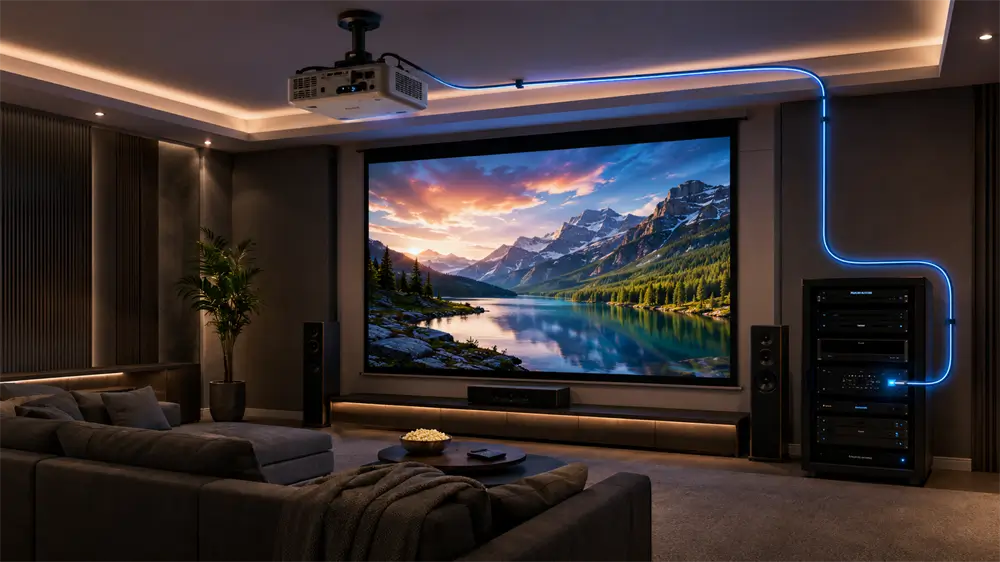
An active HDMI fiber optic cable is most suitable when the HDMI run is long, hidden, or performance-critical. In a home theater, the video source may be placed in an equipment cabinet while the projector is mounted on the ceiling. In a meeting room, the computer or matrix switch may sit at a conference table while the display or projector is installed several meters away. In a monitoring room, multiple display screens may need long and stable connections from control equipment.
It is also useful in stadiums, shopping malls, airports, schools, exhibition halls, churches, and digital signage systems. These environments often need reliable long-distance signal transmission and clean cable routing. A regular copper cable may work for a short desktop setup, but a fiber optic HDMI cable is the better engineering choice when distance, interference resistance, and installation neatness all matter.
How to Choose the Right HDMI Fiber Optic Cable
The first rule is to match the cable specification to the device. A 4K@60Hz display system usually requires HDMI 2.0-level bandwidth, while 4K@120Hz gaming or 8K@60Hz output requires an HDMI 2.1-level solution. Choosing a lower-spec cable for a high-spec device may result in reduced resolution, lower refresh rate, unstable display, or no signal.
The second rule is to check direction before installation. Most HDMI AOC cables are directional. The connector marked “Source” must connect to the signal output device, and the connector marked “Display” must connect to the TV, monitor, projector, or screen. If reversed, the system may show no signal. Direction labeling is a common feature in active HDMI installation products, and VCOM’s troubleshooting materials also emphasize that active HDMI fiber optic cables contain conversion chips and require correct direction.
The third rule is to reserve extra length. In real installations, cables rarely run in a perfectly straight line. Ceiling routes, wall conduits, cable trays, and rack cabinets all add distance. A few extra meters can prevent tension on connectors and reduce the risk of installation failure.
The fourth rule is to choose a reliable brand. HDMI AOC cables are more technical than basic copper cables, so connector quality, chip stability, shielding, bending tolerance, and manufacturing consistency all matter. VCOM provides HDMI cable and AOC solutions for different AV installation needs, including 4K, 8K, HDMI 2.0, HDMI 2.1, and next-generation HDMI product categories.
Tag:Active HDMI Fiber Optic Cable